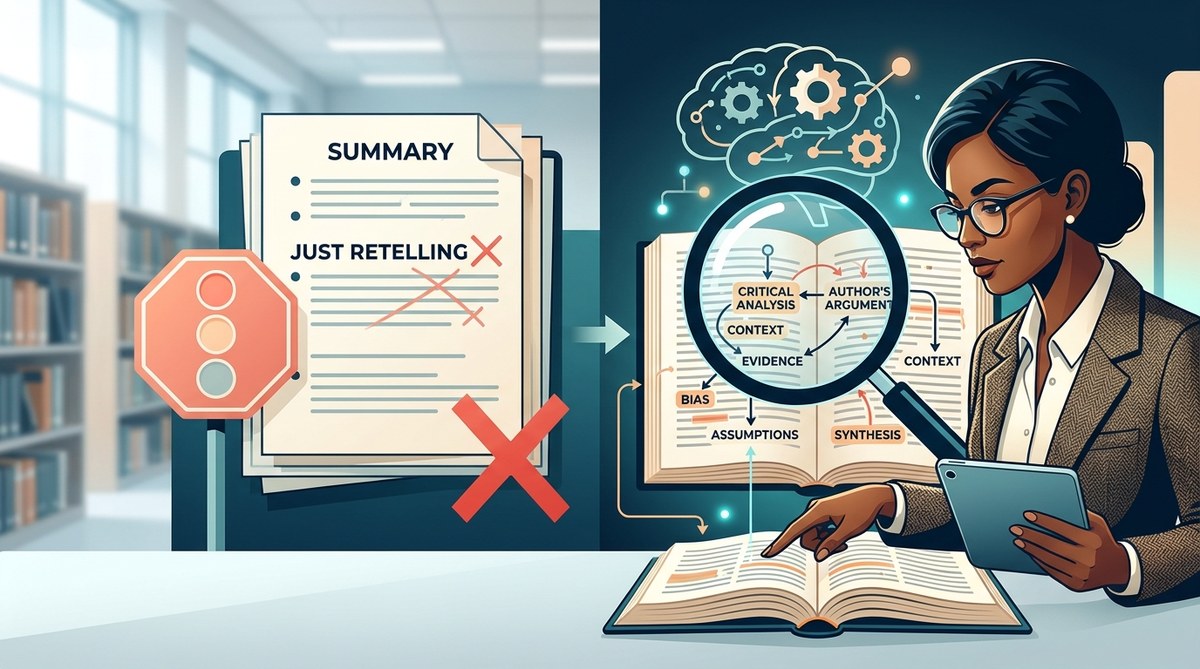
Stop Summarizing: How to Analyze Sources Like a College Professor
You open your laptop. You have a stack of sources. Your professor wants analysis, not summary. But what does that actually mean?
Most college students fall into the summary trap. They restate what a source says without adding any original thought. It feels safe. It feels like you are doing the work. But professors read summary and think: “So what? I can read the article myself.”
Analysis is different. Analysis is the act of breaking something down, examining its parts, and making a judgment. It is the difference between telling someone what a movie is about versus explaining why the lighting in a single scene creates tension. This guide will show you exactly how to analyze sources instead of summarizing, using the same moves that college professors use when they write and teach.
Summary tells readers what a source says. Analysis tells readers why it matters, how it works, and where it falls short. To analyze, you must interrogate assumptions, identify rhetorical moves, weigh evidence, and position the source within a larger conversation. This shift doubles your critical thinking and raises your grade.
The Core Difference Between Summary and Analysis
Summary is a report. Analysis is an argument.
When you summarize, you compress the original text into a shorter version. You focus on the main points, the key findings, or the central claim. The author drives the bus. You are just a passenger describing the route.
When you analyze, you take control. You decide which parts of the source deserve attention. You ask hard questions about the author’s choices. You connect the source to other texts, theories, or real-world events. You evaluate whether the argument holds up.
Here is a practical way to check yourself. After you write a paragraph about a source, look at the first sentence. Does it start with “The author argues that…”? That is summary territory. Does it start with “This argument is compelling because…” or “The author’s reliance on X is problematic because…”? That is analysis.
Three Moves to Transform Summary into Analysis
Professors do not use a secret formula. They use repeatable moves. Here are three of the most effective ones.
Move 1: Interrogate the Assumptions
Every source rests on assumptions. These are beliefs the author takes for granted without proving them. Your job is to find them.
Ask yourself:
– What does this author assume about human nature, society, or knowledge?
– What does the author assume the reader already knows or believes?
– What evidence would challenge these assumptions?
For example, if a study assumes that economic growth is always good, you can question that. You can point out that growth can harm the environment or increase inequality. That is analysis. You are not just reporting the study’s findings. You are revealing the hidden framework underneath them.
Move 2: Identify Rhetorical Moves
Authors do not just present facts. They persuade. They use specific techniques to make you trust them, feel urgency, or dismiss counterarguments.
Look for:
– Emotional language (pathos)
– Appeals to authority or data (ethos and logos)
– The way they frame the problem
– What they choose to leave out
When you name these moves, you show your professor that you see the text as a constructed artifact, not a neutral window into truth. This is a hallmark of college-level writing.
Move 3: Weigh the Evidence
Not all evidence is created equal. A source might cite a single study from 1985 as if it settled the matter. Another source might use anecdotes to support a sweeping claim.
You can analyze the evidence by asking:
– Is the evidence current?
– Is the sample size large enough?
– Does the evidence actually support the claim, or is there a logical gap?
– What kind of evidence would strengthen the argument?
By evaluating evidence, you move from being a passive reader to an active judge.
A Practical Process for Analyzing Any Source
Follow these steps the next time you sit down to write about a source. This numbered list will keep you on track.
- Read the source twice. The first time, read for comprehension. The second time, read with a pen in your hand. Underline anything that feels surprising, weak, or suspicious.
- Write one sentence of pure summary. Get it out of your system. “This article claims that social media causes loneliness.” Now set that sentence aside.
- Ask the three questions. What assumptions does this source make? What rhetorical moves does it use? How strong is the evidence?
- Write a claim about the source. This claim should be your original take. For example: “While the correlation between social media use and loneliness is well-documented, the author’s reliance on self-reported data weakens the causal argument.”
- Support your claim with specific examples from the source. Quote a line that shows the weak evidence. Point to a paragraph where the author uses emotional language.
- Connect the source to something outside itself. This could be another reading from your class, a current event, or a theoretical concept. This step shows synthesis, which is analysis at a higher level.
Common Mistakes That Keep You Stuck in Summary
Some habits are hard to break. Here is a table that shows the difference between common mistakes and their analytical fixes.
| Mistake | What It Looks Like | The Analytical Fix |
|---|---|---|
| The laundry list | “First the author says X. Then the author says Y. Finally the author says Z.” | Group the author’s points by theme or logic, then evaluate one theme at a time. |
| The orphan quote | Dropping a quote without any explanation of why it matters. | Follow every quote with a sentence that starts with “This reveals…” or “This is significant because…” |
| The agreement trap | “I agree with this source because it makes good points.” | Instead of agreeing, ask what the source gets right and where it falls short. Nuance is analytical. |
| The biographical intro | “Dr. Smith, a professor at Harvard, wrote this article in 2022.” | Only include author credentials if they directly affect the argument’s credibility. Otherwise, get to the ideas. |
What Synthesis Adds to Analysis
Analysis and synthesis are close cousins. Analysis takes a source apart. Synthesis puts it back together with other sources.
When you synthesize, you are not just analyzing one source in isolation. You are showing how two or more sources speak to each other. Do they agree? Do they contradict each other? Do they study the same problem from different angles?
“The best academic writing shows the reader a conversation happening. You are not just reporting what each person said. You are the moderator who points out the tensions, the shared blind spots, and the unresolved questions.” — Adapted from advice given by writing center directors at major US universities.
To practice synthesis, try this exercise. Take two sources on the same topic. Write a paragraph that starts with a claim about the topic, not about either author. Then use both sources as evidence for your claim. This forces you to analyze and synthesize at the same time.
A Checklist for Your Next Draft
Before you submit your next paper, run through this bulleted list. It will catch summary before your professor does.
- Does each body paragraph make a claim that is my own, not just a restatement of a source?
- Do I use at least one of the three analytical moves (assumptions, rhetoric, evidence)?
- Is every quote followed by at least two sentences of my own analysis?
- Have I connected this source to at least one other source or idea?
- If I removed the source’s name, would the paragraph still make sense as my argument?
If you answered no to any of these, you have more work to do. That is okay. You are learning a skill that takes practice.
How to Build a Persuasive Argument in Your Essay
Once you learn how to analyze sources, the next step is weaving those analyses into a coherent argument. If you want to go deeper on that skill, check out this guide on how to build a persuasive argument in your essay. It pairs well with the techniques you are building here.
A Final Look at Your Own Writing
Let us apply analysis to the act of writing itself. Think about the last paper you wrote. Pick one paragraph. Read it again. Did you tell the reader what a source said, or did you tell the reader why it matters? Did you challenge the source, or did you just summarize it?
Most students realize that their paragraphs are top-heavy with source material and light on their own thinking. The fix is not to use fewer sources. The fix is to do more work with each source you include.
Your Next Step Toward Mastery
You now have a toolkit. You can interrogate assumptions. You can name rhetorical moves. You can weigh evidence. You can synthesize across texts.
The hardest part is remembering to use these tools when you are under a deadline. Build a habit. For your next three assignments, write the analytical claim before you write the summary. Let your own argument lead. Let the sources serve your argument, not the other way around.
If you want more structured guidance, the 7-step framework for writing A+ essays every time can help you organize these analytical moves into a repeatable writing process.
Professors do not want to see that you read the book. They want to see that you thought about the book. That is the difference between a B and an A. That is the difference between summary and analysis. You have the tools. Now use them.